Brideshead Relinquished
The big-screen adaptation of “Brideshead Revisited” opens July 25 in the US. “The Passionate Spectator” columnist Robert Sacheli recently attended a press screening. The following are his thoughts on the film, as well as the charges of sacrilege leveled by fans of the 1981 Granada Television version.
Outrage against cultural debasement becomes a dandy as much as a good pair of white summer flannels, but the new film adaptation of “Brideshead Revisited” has stirred up a level of feverish emotion ill suiting the man of bemused detachment.
Why has the film hit so many exquisitely sensitive nerves? Perhaps because revisiting “Brideshead” in 2008 is less a threat to the cultural legacies of Evelyn Waugh or Granada Television than it is to our own memories of the 1981 series and the role it holds in our lives.
My own sacred and sometimes profanely silly “Brideshead” connections reach back to high school. Despite the questionable erotic themes — and possibly more problematic, the Jesuit bias — the Brothers of Holy Cross judged “Brideshead Revisited” to merit a place on our summer reading list as we headed into junior year. I’m now deeply ashamed that a hasty late-August skim through the novel left no lasting impression except for its cover illustration, a floridly rendered version of the Brideshead fountain with a pair of male and female figures ominously dwarfed by its sculptural glories.
The now-legendary television series, though, was quite another story. I was as guilty of being a “Brideshead”-head as the next impressionable fellow in the early ’80s. I had an English friend record my answering machine greeting with the series theme swelling in the background. Spellings such as “emphasised” spilled from my fountain pen. I admit to have spoken the phrases “unused to wine” and “would your friend care to rumba?” in actual conversations.
In short, I joined a brotherhood of millions who happily fell for a seductive vision of inter-war England as filtered through the lens of Thatcherism. With that memorable baroque trumpet theme echoing in our imaginations, we daydreamed about cricket sweaters, plover’s eggs, and perpetually indulgent nannies.
Yes, we thought, this is when and how we deserved to have lived.
Burnished in our affection by repeated DVD marathons, “Brideshead” was a comforting return to our youth — or at least the imaginary version we’d assembled from Waugh’s seductive characters and the glow of high-level art direction.
So it’s understandable that there might be reluctance towards Brideshead II. Better to boycott the local cineplex with a wearily dismissive attitude.
Sorry to spoil your fun, but this version of “Brideshead” is neither a desecration nor a disaster. Rather it’s a refocused approach to the novel’s story and characters — a necessary step when adapting any work of literature for the screen.
A handful of the changes wrung on it by director Julian Jarrold and screenwriters Andrew Davies and Jeremy Brock may come off as questionable or overstated, but it’s a generally reverent and respectable piece of work, and it’s unfailingly handsomely designed and shot. Think of the television series as grand opera and the film as chamber music, a set of more intimately scaled variations on a heroic theme.

The most astute choice on the part of the moviemakers was casting several major characters with performers far removed physically and temperamentally from their TV-series counterparts. Dark-haired Hayley Atwell has a ripe physicality that makes Julia’s allure both softly flirtatious and aggressively direct. Julia Quick had the luxury of gradually unveiling the passion simmering just below her character’s silken, aristocratic reserve; Artwell’s flapper hasn’t the time for coyness.
Ben Wishaw is dark, slight and nearly elfin, not a golden boy like Anthony Andrews. His fragile, floppy-haired Sebastian comes off as far more damaged by his inherited and self-inflicted demons. Though perhaps less interesting in the earlier parts of the story, it’s an interpretation that pays off later. Where Andrews crumbled into a grandly wrecked wastrel, Wishaw conveys a moving near-serenity in his final exile among the Moroccan monks.
Matthew Goode has the right opacity for the initially wide-eyed Charles, and though his voiceovers often recall the controlled cadences of Jeremy Irons, he taps into a deeper vein of sensuality than his predecessor. The film’s rumored emphasis on homoeroticism turns out to be a few playful bathroom shots and a rather decorative kiss; fans expecting a threeway with Aloysius will be disappointed.
Jonathan Cake (a more perfect Waugh name would be hard to imagine) makes Rex less a bumbling provincial than a man who pointedly deploys his energetic vulgarity against an aristocracy he’ll usurp with his money and ambition.
The wonderfully pompous Boy Mulcaster appears in a single scene at Sebastian’s Oxford luncheon party. Joseph Beattie’s Anthony Blanche frustratingly flits out of the action for great stretches (and, oddly, is assigned to deliver a variation on the famous “twitch upon the thread” line). Ed Stoppard brings an appropriate young fogeyish stiffness to Lord Brideshead, though we’re never allowed to see much beyond that single dimension. We do get a brief, hilariously telling glimpse of Bridey’s humble matchbox collection amid the baronial bric-a-brac.
The screenplay finds its focus in the sins committed in the guise of familial love, and it’s the players who portray the older generation who come to dominate the movie. Emma Thompson, wearing her steel-gray hair as if it were a royal tiara, suggests a note of desperation beneath Lady Marchmain’s armor of piety and manipulativeness. Michael Gambon taps into the veiled Byronic swagger that Waugh ascribes to Lord Marchmain’s appetites and anger. Instead of Gielgud’s delightful old loon, Patrick Malahide brings out the malevolence in Ned Ryder’s obliviousness, underscoring the emotional lure of the Marchmain clan for poor Charles.
Will some viewers be disappointed that this is not their cherished vision of “Brideshead”? Certainly. But then again, the strength of that that personal vision certainly ought to endure assaults more egregious than a commercial film.
As for me, I finally made it to Brideshead. My pilgrimage to Castle Howard took place more than a decade after I’d first seen the series, and though it was my first visit it had a the feeling of a return. The rooms, the art and the grounds — particularly the fountain — were suitably impressive when liberated from the proportions of a television screen. But part of me was strangely let down. I expected a gift shop stocked with Fair Isle pullovers and antique stud boxes. I found teddy-bear key chains, refrigerator magnets and frisbees. In the end, it didn’t matter. I still had my memories of “Brideshead,” distilled as they were through Evelyn Waugh and Charles Ryder and Jeremy Irons.
But now I had my own remembrance of the place to add to them. I also had something more, a powerful talisman of memory that neither the story’s author nor his characters could have imagined.
I had the refrigerator magnet.


If filmmaker Catherine Breillat could be anyone in the world, she’d be the man pictured at left. Yes, the guy who looks like Lemmy from Motorhead dressed for the Dickens Fair.
Catherine Breillat’s “
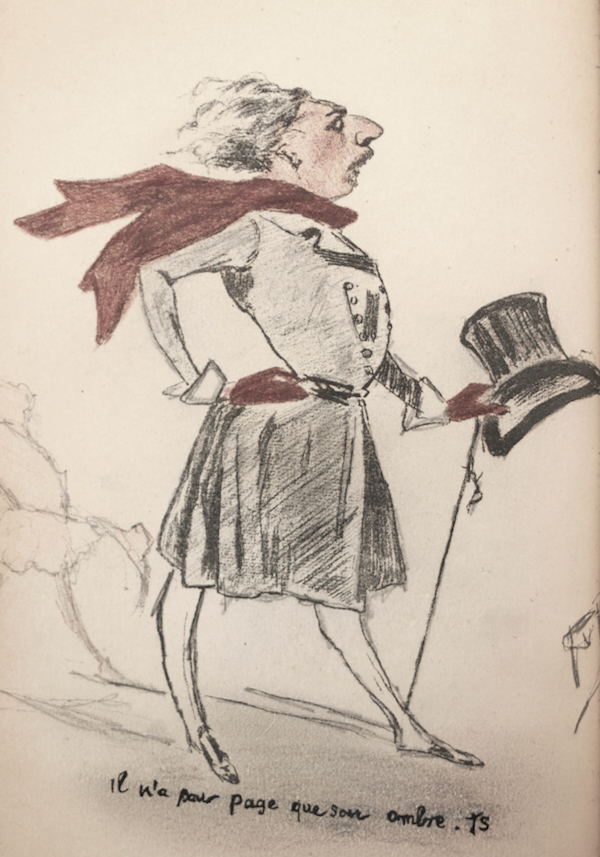
In 1844, at the height of his fame, Count Alfred d’Orsay found himself lampooned in print. Writing under the pen name A Man of Fashion, popular novelist John Mills published “D’Horsay: Or the Follies of the Day.” The whiff of scandal that ensued did little to obviate d’Orsay’s demand in society, perhaps because it failed to address the Count’s apparent seducing of wife, husband and daughter in the Blessington family.
Dandyland is buzzing with cynicism over the imminent release of the big-screen version of “Brideshead Revisited,” which opens August 1 in select U.S. theaters.
Dedalus Books, publishers of such dandy classics as “The She-Devils” by Barbey d’Aurevilly and “Monsieur de Phocas” by Jean Lorrain, has put out a new edition of J.-K. Huysmans’ seminal work of French Decadence, “
June 1, 2004 is a day that will forever live in dandy infamy: The debut of Dandyism.net. This year “The Passionate Spectator” columnist Robert Sacheli smugly looks back on the latest year that was.
Following hard upon Robert Sacheli’s three-part biography on Lucius Beebe, D.net founder Christian M. Chensvold has written